Ads used to be here |
 |
 |
 |
 |
 |
 |
 |
 |
|
A
Roundtable Discussion with
The "Notorious" Margaret Cho (Part 1 of 2) ("Notorious C.H.O.") by Lia Chang |
||||||
|
||||||
|
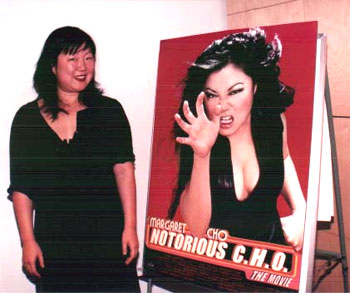
AsianConnections' Lia Chang caught up with Margaret Cho in New York July 1 on the premiere of her new concert film "Notorious C.H.O." - a follow-up to her hit concert film "I'm the One that I Want." "Notorious C.H.O." filmed live in Seattle, is a hilarious, bawdy one-woman show inspired by the raw comedy of Richard Pryor, George Carlin and the female machismo of rap music divas L'il Kim and Eve. At the press roundtable Margaret shares her thoughts about growing up as a "dorky" kid, her role models, racism in Hollywood, and how she has finally achieved both personal and career success. The film debuted in Los Angeles and New York and will follow with a national release through Wellspring. "Notorious C.H.O." is also released as a CD, "The Notorious C.H.O. at Carnegie Hall" is available through Nettwerk America. For more information on the film, visit www.margaretcho.com
On the issue of having children. Yeah! I love children. I would love to do that. The whole parenting, mommy thing someday. Although I don't know when that would happen. I got very excited because my dog was in the daily news this way. "Oh she's in the newspaper!" I don't care about myself but I'm excited for her. She and I were photographed together so she was next to me. And she looked so happy. On what drew her to stand-up comedy Well, I always really wanted to be a performer and I started at a young age. And I think it was just something that I knew that I would do, that I knew that this was my job. And nothing in my life pointed to that. I wasn't an outgoing kid at all, I was very shy. I was very studious as a lot of Asian Americans are at that age. But I knew there was something inside of me that needed to kinda break from that so I just started doing that. On role models My role models initially, when I was really starting - I think Richard Pryor was a big one. I remember watching his movies. We had gotten a VCR. It was kinda like a big deal, this was the early 80's. We had one of those VCRs that was wood, wood paneling around the side. It was very old and it had those big keys that you would push down like a Radio Shack tape recorder. So we would rent Richard Pryor movies and laugh and laugh. So he was a big inspiration. Flip Wilson was a big inspiration. I remember seeing Johnny Yune on The Tonight Show in the late 70s, and he was a really inspiring person because he was on The Tonight Show doing comedy. It was very exciting. On pushing boundaries I didn't think that I ever went too far in this show. Although this show does go probably into more personal territory than I did before. I think that I enjoy talking about these things because it's real. It's got a real emotional charge for me. I don't mind it. I don't think I really like people's work when it - does it really touch on real emotions? I really like artists who are about "blood and guts." I really want to see people's pain and heartache and sadness. And there's a point in it. And that's what's really valuable about certain types of art, and I would really like to do that myself. On her future direction I don't know. The next show I'll do will probably be more political. The next show is a lot about race identity and Asian American identity. That's my next show, so that may go into slightly less personal territory. But I also don't know about the show because I'm not finished [with] it yet. On her favorite parts about putting together a show I think the most challenging thing about putting a show together is just the touring that it entails because I do have to still tour even though I'm not on tour officially. I have to go to smaller venues and try things out. The most fun thing for me is write something new and have it work and have it become a part of the show. That's really great to create something out of nothing, it's a real thrill. So that's what keeps me going. I do love writing new things, I do love creating new work and I'm looking forward to the next year which will contain all that, all three items. On the audiences in Scotland The Edinborough audiences were very different than American audiences, and certainly different from audiences that I had experienced before. It's a whole different culture and they viewed women in an entirely different way, especially women in comedy. It's different because they don't have a lot of women comics just working by themselves, that a lot of women in comedy in Britain work as either a double act or part of a sketch group, but they are rarely just talking about true love experience. And that's sort of really "men's territory." And so there was a very different reaction to the show because what I was talking about was extremely shocking to them. Not in a volatile way, but in a surprising fun way, but it was still a shock, so it was hard. I just thought that the whole festival was just a very difficult place to be because you're basically competing against 1600 other shows happening at the same time as yours. It's like a great thing because I enjoyed hanging out with the other performers. I made a lot of friends. I was always somewhat of an Anglophile, so that was cool because I kinda hanged around a lot of very great, great people, which was fun. So I would definitely go back, but it was certainly a challenge to do a show there and to start there. On growing up I grew up in a couple of different environments because the school that I went to was very Caucasian, but then I would go to school on Saturdays and Sundays which was exclusively Asian. So I would be in two different worlds all the time. And I was surrounded by sort of hostile people in both situations. Because I would go - I never had friends in school, I was really unpopular and then I would go to Korean school and then Sunday school in which I was like wildly unpopular. Because I think we all went to schools that had exclusively Caucasian kids, and so we would get up so much angst and aggression towards us that when we didn't feel comfortable lashing at our Caucasian schools, but when we got to our Asian school where everybody was just like us, it was like we were free and we just let it all out. But of course, I kind of got the worst of it because I was so weird, I was just like a really weird kid. And I was really, like, earnest and I would say things so excitedly, and I was just so uncontainable, they could never contain me and I was never cool. So I never had a good experience in school and I was always very dorky. So I just didn't have a good time. Yeah, it was hard. On her present situation It's great. I'm very happy with my work now, I'm very happy with the way that I've been able to write everything and produce and do my own stuff. I really treasure that, it's very important for me to retain that autonomy. Advice for other Asians and Asian Americans There is sort of a need to perform to an extent because of the way society is, because of the way that opportunities are so limited. And if you want to take advantage of those opportunities, you often have to compromise your own beliefs. So it's hard. They should sort of do what they feel is right, but to make their own opinions count more than anyone else's. That's the best advice I can give any artist is to make your own voice the loudest, and every kind of argument that you have with anybody else, to listen to yourself as much as you can.
On the hardest part of her job I think it's traveling. I think it's the constant travel that - I'm very nomadic. And I have been for a very long time. And it gets harder when I do things like writing a show because I'm going back and forth between places. And this is hard to, the promotion schedule is pretty rough. But I love the film and I really want people to go see it so I'm very happy to do as much for it as I can. On preparing before a show No, I don't have a pre-show situation. Like no shadow boxing, no warm-ups. I'm pretty lazy when it comes to that. I was trained in the theater but I rarely go back and do any kind of vocal preparation. I'm really not very superstitious when it comes performance. I just kind of go and do it. Maybe because I do it so much, it's just not any kind of special thing to me. When I had jobs before, I never went and said a nursery rhyme before I went into the office. So there was no kind of "thing" that I do, no ritual. On the differences between her first film and Notorious C.H.O. I think that the first film, "I'm the One That I Want," was really a coming of age story. It's about racism in Hollywood. It's a very specific show about the experience of doing television as a minority, and how it affected my own ideas about race and how other people treated race as an idea. This show is really about everything. I think there's a lot of topics that it covers. Mostly I think it deals with self-esteem and the search for happinesss, and gender politics and the way they affect small interactions between people. So there's a great difference in material in both shows, but I think they're both funny. I think "Notorious C.H.O." is a better film overall because I enjoy it more. I think I'm closer - I think it's a better representation of what I enjoy doing, although I think they're both great. I think the first film had an advantage in that it was shot on film. And this film is very different visually because it was shot on digital video and edited on an iBook. Which is pretty revolutionary. I mean, it's really changing the way independent is going to look in the next several years, so it's exciting to take advantage of this technology and to have been able to make a film with such a small budget, so I'm really happy with that. On the budget of Notorious C.H.O. It was actually - I don't know the exact numbers because we're not finished with counting everything up, but it was probably less than $500,000. On finding a distributor for the film The way that we worked it out with the last film really made people want to get into business with us. Because the film that came before this, we distributed ourselves. I traveled with the film, I would lecture with it, I would tag along as an "added bonus" to the film. So it became a road show, it was really a great way to bring people into the theater. And I wanted to do that with this film as well. And so it was easier after having such a success with the last one to get a distributor that would listen to everything that...we were initially going to be shooting this film ourselves, but we found a company that was really supportive of us and would let us do anything that we wanted. On the response at the New York Gay and Lesbian Film Festival Oh, it was tremendous. It was a great, great festival. And I'm so honored to be chosen as the opening film there. I just thought that they were so supportive and so wonderful - it was like performing. That was a very strange experience because it was the first time that I'd actually seen it with an audience. So to sit there with them, I felt very satisfied and very proud that I did the film and I thought they were really supportive and really wonderful. On her parents' reactions Oh, they loved it. They were laughing hard. They were great. My dad brought along this World Cup towel, it was so embarassing. When everyone was being introduced in the film and you sit up and everybody's like clapping, he holds up this World Cup towel [laughter]. And he's so into the fact that Korea was hosting the World Cup this year. They loved it. Upon being asked to comment on her statement in Weekend Taste: "But now I want to make the political statement of I'm not going to put the power of my self-worth into the hands of advertisers and television executives or be connected to an idea society is supposed to treasure. I want to put that power into my own hands." It's really about the fact that I spent so many years very unhappy with myself in the way that I looked and the way that I was and my race and my body. All that stuff was so oppressive. I was so upset with the fact that I was not white, that I was not blonde, that I was not all these things that I wanted to be, that I had actress friends who got jobs left and right because they were what the media was looking for, what the advertisers were looking for or whatever. But I kept getting passed over for so many years for jobs because of my appearance and not my talent. And I was so willing to self-destruct over that. For years, I struggled with eating disorders, for years I struggled with a sense of inferiority to these other people that didn't really have anything over me except for the way that they look or the way that they appeared. So having placed such a high value on looking a certain way, I really destroyed a large part of my life. So now, I've kinda gotten to the age where I really can't do that anymore. I don't see the reasoning behind it. I lost my taste for self-destruction. It's just not interesting to me. I learned that I had no idea who I was without this self-hatred. And existence had become so boring, so I decided to sort of let it go. And as I let it go, a whole new world of opportunities opened for me. And it also allowed me to maybe guide other people to that same experience of letting go of self-hatred. For whatever reason, most people have it to a certain extent for this reason or that reason, and there's incredible freedom when you can release it and when you can live without it. So statements like that, I make often, and I try to make them as clear as I can without being too self-helpy because you can also very much talk about it in a way that's very esoteric that's really boring, too. On AIDS and drug awareness within the Asian community It's just something that people have ignored in our communities for a long time. It's such a taboo subject. Even homosexuality. Without even talking about AIDS, homosexuality is regarded with such disdain in so many Asian cultures and that gay men and lesbians have felt so invisible within our communities, and I think that's really destructive. I think there needs to be much more support there, much more breaking away from Old World traditions around these thoughts and ideas about homosexuality. In terms of drug users who are just ignored by the government or ignored by the media, our problems are really not looked at as being an issue because in that idea of what Asian Americans are, in that sort of "model minority" myth that we're not supposed to be that way, so many people suffer because we don't have attention put on us with these problems, so I think it's a big issue. On the response by the Korean community in particular I think it's great. I don't know what different generations have to say about me. I think the older generation probably doesn't really approve of what I'm doing. I don't see how they could because my work is so kind of out there. But at the same time, I think it lends such great visibility to Koreans that I think that's really a great thing. A lot of the younger people that I've encountered have grown up with me and are very excited by all the things that we do. We can expand the notion about what Asian Americans are and what Korean Americans in particular can do. On the topic of Asians in Hollywood in non-martial arts roles I hope so. I would really love to see that. I know that there is a real need for that. Because we're just not seeing ourselves represented in any way. Even though there are great people coming out of Asia that I love, I think that it reinforces the idea that we're foreign and that we're not really American. And you know, it seems that for Asians to be in movies these days, you have to have special powers, and it's not fair. So I would love to see more Asian Americans in the media in any capacity. Read Part 2 of this fascinating roundtable with Margaret Cho! |
||||||
|
|





 AsianConnections
Team Correspondent Lia Chang (left) is an accomplished stage, screen
and TV actress, photographer and writer based in New York City.
AsianConnections wishes to thank Lia, Margaret Cho, and AC's Suzanne
Kai (middle) and Paul Lee (right) for their generous time and efforts
in making this interview possible.
AsianConnections
Team Correspondent Lia Chang (left) is an accomplished stage, screen
and TV actress, photographer and writer based in New York City.
AsianConnections wishes to thank Lia, Margaret Cho, and AC's Suzanne
Kai (middle) and Paul Lee (right) for their generous time and efforts
in making this interview possible.  |
|||
|
 |
|
|
| | About Us | Disclaimers and Legal Information | Advertise With Us | We welcome your comments. Send e-mail to us at info@asianconnections.com Copyright ©1999-2002 AsianConnections.com |